Table of Contents
Are Expensive Body Products Worth It? A Formulator’s Honest Answer
Most of us would never grab the cheapest face cream off the shelf and expect it to do much for our skin. We’ve been trained, by years of skincare marketing and our own trial and error, to believe that what we put on our face matters. Some of us don't even think twice about expensive body products and beauty creams because we know that ingredients matter. Concentration matters. Formulation matters. So why do we abandon all of that logic the second we walk down the body care aisle?
I’ve spent years formulating body care, first as the founder of Fiorella Soapery, where I made handmade bar soap from scratch starting in 2018, and now as the founder and formulator behind Solette Beauty. In that time, I’ve mixed, tested, and reformulated more body butters than I can count. And I can tell you with total confidence: the gap between a cheap lotion and a well-formulated body butter is not a marketing illusion. It’s chemistry. It’s ratios. It’s what’s actually in the jar.
So let’s talk about why investing in higher-quality body care is worth it, using my own formulation as the case study, because I think showing the actual numbers is more convincing than just telling you to trust me.
The Water Problem Nobody Talks About
Here’s something most shoppers never think to check: how much of that bottle is actually water. Lotion has to be a certain texture to pump out of a bottle, and the cheapest way to hit that texture is to dilute it. A lot of mass-market drugstore lotions run anywhere from 70 to 80 percent water. That’s the very first ingredient doing the least for your skin, and there’s a whole lot of it.
When I formulate a Solette body butter, water makes up around 40 percent of the formula. That difference isn’t a small tweak, it completely changes what’s possible in the rest of the recipe. Less water means more room for the ingredients that are actually doing something for your skin: the butters, the oils, the emollients. You’re not paying for a fancier jar of mostly water. You’re paying for a better ratio of ingredients.
This is the same logic we already apply to facial skincare without thinking twice. Nobody is surprised that a $12 serum with water as the top ingredient performs differently than a $60 serum loaded with actives. We just haven’t extended that same scrutiny to the body care aisle yet.
What Actually Fills the Other 60 Percent
Cutting the water is only half the story. What you replace it with matters just as much, so here’s exactly what goes into our body butter, and why I chose each one.
Shea butter — this is our primary moisture and barrier-repair ingredient. It’s rich in fatty acids and naturally occurring vitamins, and it’s the ingredient most responsible for that deeply nourished, not-just-surface-level feeling.
Glycerin — a humectant, meaning it pulls moisture in and helps the skin hold onto it. This is part of why our butter keeps skin feeling hydrated hours after you apply it, rather than just sitting on top temporarily.
Caprylic/capric triglyceride (MCT oil) — a lightweight emollient derived from coconut. This is the ingredient doing a lot of the work to keep a butter this rich from feeling heavy or greasy. It helps everything absorb instead of sitting on the surface.
Sunflower seed oil — another lightweight oil, high in linoleic acid, that supports the skin barrier without clogging or feeling sticky.
Emulsifiers — what allow the oils and water phases to actually combine into a stable, smooth product instead of separating in the jar.
Fragrance, at just 1 percent — this one is intentional, and lower than a lot of industry formulas. Overly fragranced body products can feel overwhelming, especially in a body butter you’re applying generously all over. I’d rather the scent be a quiet, lasting presence than something that hits you the second you open the jar and fades an hour later. If you're looking for a body butter that's stronger than a perfume...Solette may not be the brand for you. Learn more about fragrance and safe synthetics here.
A watered-down lotion simply doesn’t have the room in its formula for this kind of layered ingredient list. When 75 percent of a bottle is water, there isn’t much space left for shea butter, glycerin, and multiple emollients to all do their jobs at meaningful levels.
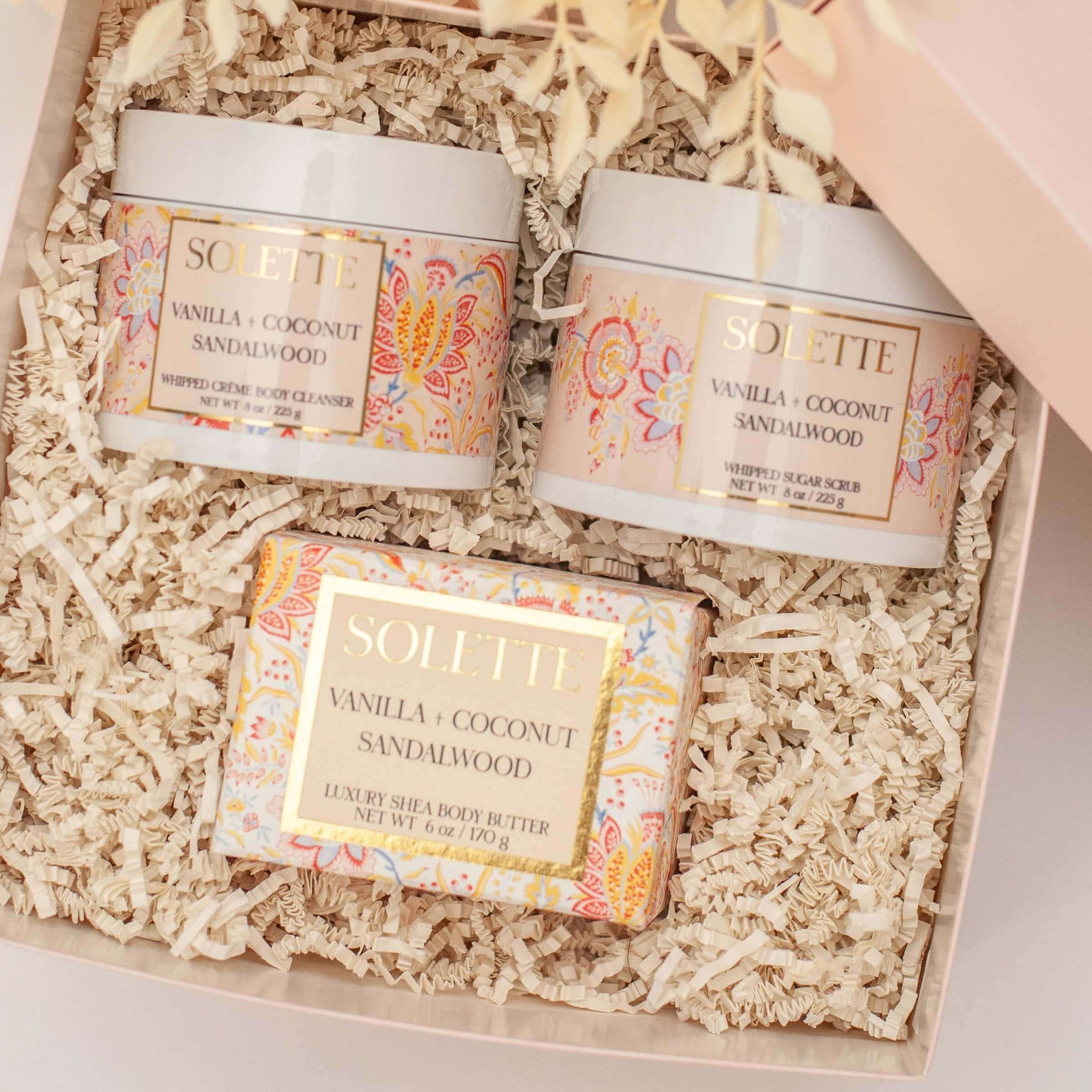
What This Actually Feels Like (In Customers’ Own Words)
I can talk about ratios and ingredients all day, but what matters is what people actually notice when they use it. A few reviews have stuck with me because they describe, almost exactly, what I was hoping to achieve when I formulated this butter.
“This body butter is incredible. Silky smooth without leaving you greasy and has the most luxurious and yet not overpowering fragrance.”
— Meg, on the Cashmere + Vanilla Creme Luxury Body Butter
“Love this scent. No need for perfume. I just apply it right after my shower. Lasts all day and leaves my skin feeling great.”
— rosemary g., on the Cashmere + Vanilla Creme Luxury Body Butter
“I got this scent last year as a gift, and totally fell in love with it. Neither the vanilla or coconut overpowering each other and it’s just so smooth.”
— Rachael S., on the Vanilla + Coconut Sandalwood Luxury Body Butter
Notice that none of these reviews mention the scent being strong. They mention it lasting, and being balanced, and not overpowering. And “silky smooth without leaving you greasy” is, almost word for word, what that combination of caprylic/capric triglyceride and sunflower seed oil is designed to do.
A Quick Checklist: What to Actually Look For
If you want to apply this thinking the next time you’re shopping for body care, whether it’s Solette or anything else, here’s what I’d actually look at on the label:
- Check the first ingredient. If it’s water (or aqua) and the second ingredient is also a thin, cheap filler, that’s a sign the formula is built around dilution rather than performance.
- Look for named butters and oils high in the list, like shea butter, cocoa butter, or specific named oils, not vague “emollients” buried near the end.
- Look for a humectant like glycerin or hyaluronic acid. This is what helps the product actually hold moisture in your skin rather than evaporating off.
- Check where fragrance falls. You can’t always see the percentage, but if a product is overwhelmingly scented the moment you open it, that’s often a sign fragrance is doing the heavy lifting instead of the actual skin-conditioning ingredients.
- Pay attention to texture in person if you can. A well-formulated, less-diluted body butter should feel rich going on but absorb without a greasy residue. If it just sits on top of your skin, the emollients aren’t balanced well.
- Ask what’s NOT in it. Clean, intentional formulas are often just as much about what’s left out (like excess water or heavy fragrance load) as what’s included.
The Bottom Line
Are expensive body products worth it? Not automatically, and not just because of the price tag. But a thoughtfully formulated one, where you can see and feel the difference in the ratio of active ingredients to filler, absolutely is. The same standards you already hold your skincare to, checking ingredient lists, understanding what a humectant does, noticing when something feels diluted, apply just as much to the body butter in your shower as the serum on your bathroom counter.
I started Fiorella Soapery in 2017 making bar soap by hand and selling it at farmers markets, and I’ve carried that same hands-on, ingredient-first approach into every Solette formula since. That perspective is exactly why I care this much about what’s in the jar, because I’m the one who put it there, batch by batch, and I know exactly what it took to get the ratio right.
Cashmere + Vanilla Creme Luxury Body Butter
$30.00
Luxury Shea Body Butter Your skin will be so happy once it meets our thick and creamy body butter. Our non-greasy formula is one of the thickest you'll find and keeps your skin hydrated throughout the day. Natural glycerin draws… read more